Equity Release: A way for homeowners to release cash from the value of their home, either as a lump sum or in installments, while still living in the property.
Debt Consolidation Australia Personal Loan Repayment Calculator
Calculate repayments with our Personal Loan Calculator. Compare loan terms, view repayment schedules, and plan your personal finance with confidence.
Calculator results are estimates only and not quotes. Actual quotes will be provided by licensed brokers after you submit an enquiry.
Personal Loan Details:
Important!
Personal Loan Interest Rates differ from lender to lender and will depend on your individual circumstances (credit history, employment status, age, etc.). To find out if you qualify ... and for a free, personalised interest rate and repayment quote,
please CLICK HERE
Personal Loan Amortisation Calculator
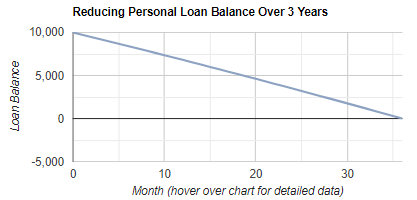
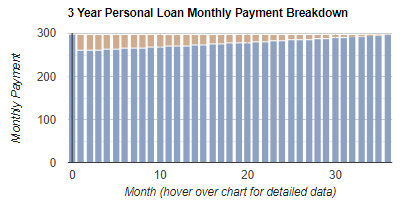
The following amortisation graphs detail month-by-month data on the progress of the proposed loan. The first chart below examines the reducing loan balance over the course of the finance contract term. The second graph illustrates the portion of each monthly repayment allocated to payment of interest vs principal reduction.
How to use our Personal Loan Repayment Calculator
Our Personal Loan Repayment Calculator helps you estimate your ongoing loan repayments and the total cost of borrowing before you apply. By adjusting the loan amount, loan term and interest rate, you can compare scenarios and choose a repayment level that better fits your budget. It also provides an amortisation view so you can see how each repayment is split between interest and principal over time.
Important note for ASIC compliance: this calculator provides general information only and does not take into account your objectives, financial situation or needs. Results are estimates and may not include lender fees, comparison rates, commissions, insurance, redraw features, or changes to your interest rate. Always check a lender’s final quote and loan contract before deciding.
How to complete the form for the best result
1. Loan Amount Required: Enter the total amount you want to borrow in Australian dollars as a whole number (no decimals or commas). Use the amount you actually need, not the maximum you might be approved for, to avoid overpaying interest.
2. Term of Loan: Select the number of years you plan to repay the loan over. A longer term can reduce the monthly repayment, but typically increases the total interest paid over the life of the loan.
3. Interest Rate: Choose an annual interest rate for the simulation. If you have a lender quote, use that rate. If not, test a conservative range to understand best case and worst case outcomes.
4. Calculate: Click the calculate button to generate your results.
How to interpret the results
1. Repayment estimate: Treat the repayment figure as your baseline commitment. Stress-test your budget by increasing the rate or shortening the term to see if repayments remain affordable.
2. Amortisation and graphs: Review the month-by-month amortisation view and charts to understand how the balance reduces and how early repayments often include a higher interest portion, shifting toward more principal over time.
3. Compare scenarios: Re-run the calculator with different terms and rates to balance affordability (cash flow) against total interest (overall cost).
A debt consolidation calculator can help you compare your current debts with a possible new loan by estimating repayments, interest and total cost differences. The result is only as useful as the assumptions you enter, so it is important to understand the inputs, outputs and limitations before relying on the estimate. - read more
Welcome to our guide on how to avoid falling back into debt after consolidating your debts. Debt consolidation can be a fantastic way to manage multiple financial obligations, combining them into a single, more manageable payment plan. But the journey doesn’t end there. - read more
When it comes to managing your finances, planning for the unexpected is a crucial part of staying on top of your budget. An emergency fund serves as your financial safety net, poised to offer support when unforeseen expenses arise. These funds are specifically set aside to cover unexpected costs, like medical emergencies, car repairs, or urgent home maintenance issues. - read more
Debt consolidation may affect your future borrowing capacity in both positive and negative ways. The outcome depends on how the new loan is structured, whether repayments are made on time, how credit card balances are managed and how lenders assess your overall financial position after consolidation. - read more
Financial stability is a common aspiration, yet many Australians find themselves weighed down by the burden of debt. Whether it’s due to loans, credit cards, or unexpected financial emergencies, the struggle to stay afloat is a reality for countless individuals striving to achieve their dreams of a secure, debt-free future. - read more
Recent consumer finance reporting has again highlighted a problem many Australians already feel in their weekly budget: emergency savings are not stretching far enough. When the cost of groceries, rent, mortgage repayments, utilities, fuel and insurance remains elevated, even a relatively ordinary surprise bill can push a household towards credit cards, buy now pay later, personal loans or payment extensions. - read more
Fresh financial complaints reporting has again highlighted a difficult reality for many Australian households: when repayments start to fall behind, the problem is rarely limited to one bill. Mortgage stress, credit card balances, personal loans, car finance, buy now pay later commitments and utility arrears can all collide at once, leaving borrowers unsure which creditor to call first or what support they are entitled to request. - read more
Recent consumer finance reporting has put buy now pay later back in the spotlight, with more Australians appearing to use short-term credit to manage everyday costs such as groceries, utilities, fuel and household essentials. On the surface, splitting a purchase into smaller instalments can feel manageable. The concern is what happens when several small commitments land at the same time as rent, mortgage payments, credit card minimums, car finance and personal loan repayments. - read more
The Reserve Bank of Australia’s latest decision to leave the cash rate unchanged gives households a moment to breathe, but it does not remove the pressure many borrowers are already feeling. For Australians carrying credit card balances, personal loans, car finance or buy now pay later debt, a steady cash rate can feel like welcome news after a long period of higher borrowing costs. - read more
The latest Australian lending indicators are a reminder that personal loans remain an important part of household finance, particularly for people trying to smooth out cash flow, cover large costs or bring several debts under one repayment. For Australians already juggling credit cards, car finance, buy now pay later balances or other unsecured debts, the trend is worth watching closely. - read more